Cadastre ·
Swimming pool not in the Cadastre: what to do in Spain
Your pool is missing from the Spanish Cadastre. Why it is worth declaring, what we measure on the plot and which plan the surveyor prepares.
A swimming pool that is not declared in the Cadastre (Catastro, Spain’s land and property register for tax purposes) is more common than it seems. It was built years ago, the previous owner built it, or nobody remembered to report it when the work was finished. If this is your case, it is usually not as serious as it sounds, but it is worth sorting out calmly and with a well-made measurement. Here we explain why it matters, what the surveyor has to do with it and which technical document is prepared.
Why might a pool be missing from the Cadastre?
The Cadastre describes every plot and every building on it. That description does not update itself: someone has to report the changes. Pools are left out for very different reasons:
- They were built years after the house and nobody declared the extension.
- You bought the property with the pool already there and the seller never declared it.
- It was built with a licence or a responsible declaration, but the cadastral step was never done.
- The property was inherited or divided and each owner assumed the previous one had done it.
In the urban developments of the Marina Alta coast it is common to find houses from the 1980s or 1990s to which a pool was added ten or twenty years later, while the paperwork kept describing the original house.
What happens if I do not declare it?
The most direct consequence is that the cadastral description of your property does not reflect what you actually have. That can affect the IBI (annual property tax) and, sometimes, a sale, a mortgage or a valuation. We explain how the tax bill and the Cadastre relate in pago de IBI.
The Cadastre can also detect buildings that are not recorded by itself, for example by comparing its information with aerial images. If it finds the pool before you do, the regularisation starts from a worse position than if you take the first step. What the financial consequences would be in your case is decided by the Cadastre and your town hall, not by us: ask your gestor, your lawyer or the Cadastre directly.
Does declaring the pool in the Cadastre make it legal?
No, and it is important not to confuse the two. Declaring a building in the Cadastre is one thing and having the licence or authorisation from the town hall is another. The Cadastre records what physically exists, even if it is not regularised under planning rules.
So before taking any step, ask the town hall whether the pool has a licence or a responsible declaration and whether anything is pending. That part is a matter of planning and law, and belongs to the town hall, an architect or a lawyer. To understand the building side better, see licencia de obra and declaración responsable de obra.
How is a pool reported to the Cadastre?
A new building, or a change to an existing one, is reported to the Cadastre through a declaration of alteration of real estate. It is submitted by the owner, or by a gestor or technician on their behalf, and it can be accompanied by graphic documentation. This is where the surveyor comes in.
We will not give you a step-by-step guide to the Sede Electrónica (the Cadastre’s online portal) here: forms and requirements change over time, and it is better to check them with the Cadastre itself or with whoever handles the procedure. What we can explain is the technical part.
What does a surveyor do in this case?
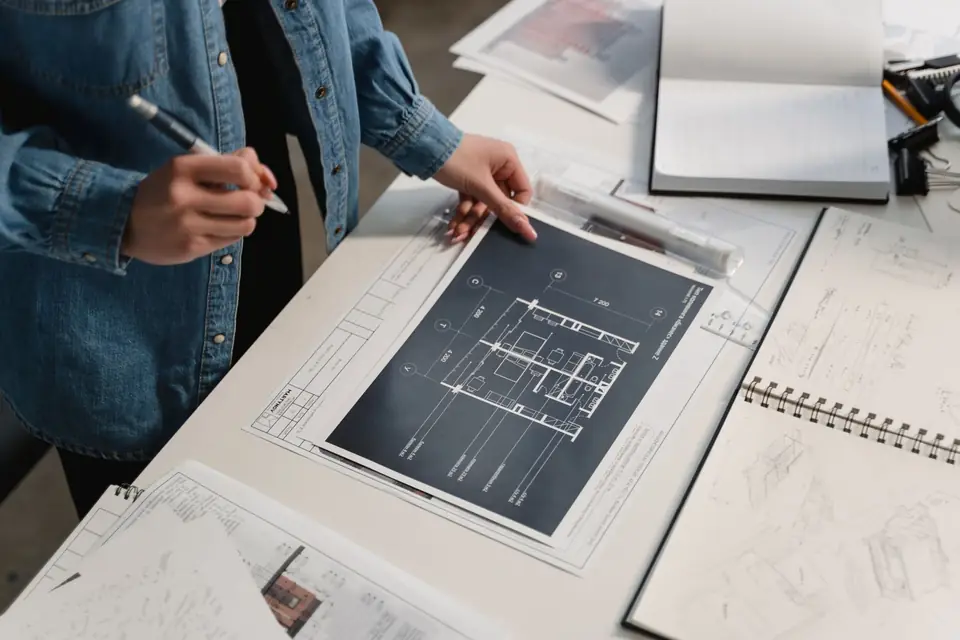
The surveyor measures what exists and draws it so that it can be compared with the cadastral mapping. For a pool, the work usually goes like this:
- We review what is recorded. We look at the cadastral mapping of your plot and at which buildings appear on it.
- We measure in the field. With GNSS RTK and a total station we take the corners of the house, the outline of the pool, the walls, the terraces and the boundaries, in ETRS89 UTM 30N coordinates.
- We calculate areas and distances. We obtain the area of the pool, its exact position on the plot and its distance to the boundaries.
- We prepare the plan. A georeferenced plan, signed by Vicent Doménech (chartered surveyor (colegiado) no. 8948), in PDF and in the formats the procedure asks for, such as DWG or GML depending on the case.
- We deliver it so that you, your gestor, your lawyer or the notary’s office can use it where needed.
If the boundaries also need updating, or the title deed (escritura) does not reflect buildings that already exist, the alternative graphic validation report (IVGA, Informe de Validación Gráfica Alternativa) and the cadastral building location report (ICUC) can be prepared. We explain them in IVGA e ICUC para actualizar la escritura. Neither of them, nor a plan, proves ownership: that is the job of the Land Registry (Registro de la Propiedad).
What do I need to get started?
The clearer what you bring, the sooner it can be measured. Ideally you have:
- The cadastral reference or the IBI bill.
- The title deed and a land registry extract (nota simple), if you have them.
- The licence or responsible declaration for the pool, if one exists.
- An idea of what you want to update: only the pool, or also the house, the outbuilding and the walls.
That is enough to start. In documentación para medir una finca you will find a fuller list.
If you live abroad and the house is on the coast
Many owners on the coast of Valencia, Alicante or Murcia live in another country and cannot be present for the measurement. We take on projects across Spain and Europe, so distance is not an obstacle: what we need is access to the plot and someone you trust to open it or accompany us. The plan and the report are delivered in Spanish.
Frequently asked questions
Is it compulsory to declare a pool in the Cadastre?
New or modified buildings are reported to the Cadastre, and a pool is one of them. The deadlines and the specific consequences depend on each case and on the rules in force: check with your gestor, your lawyer or the Cadastre itself.
Does declaring it in the Cadastre make it legal?
No. The Cadastre records what exists, but the licence or building authorisation is granted by the town hall. They are two separate procedures.
Do I need a surveyor to declare a pool?
A georeferenced plan with the pool measured avoids mistakes in area and position, and it is useful if you later want to sell, mortgage or update the title deed. Ask whoever submits the procedure which documentation it requires in your case.
Can I declare only the pool, without touching anything else?
It depends on what needs updating. If only the pool is missing, the measurement is limited to it and to its position on the plot. If other buildings are also undeclared, it usually makes sense to measure everything at once.
If you have a pool that is missing from the Cadastre and you want it measured and a plan prepared, tell us about your case through Catastro y Registro or see how we work in plot measurement and boundary survey.
Tags catastroactualizacion catastralibiplano
Written by Vicent Doménech, geodesy and cartography engineer, chartered surveyor no. 8948.